MOUSELING.net
Kraftwerk lied to me! This calculator can't fit in my pocket at all.

If you have ever listened to the band Kraftwerk, the Japanese-language release of their song about little calculators that play a little melody when you press a special key may have taught you the Japanese word dentaku. Language learning can be fun!
Just one thing, though: most words starting with den, which means electricity make perfect sense. A utility pole is den-chuu, an "electric pole". A train is den-sha, an "electric vehicle". A telephone is den-wa, for "electric speech". But den-taku means "electric table". What on earth does a pocket calculator have to do with the idea of an electricity-powered table?
It all comes down to how, in 1964, a Japanese business owner had a choice: he could buy a brand new car and drive his family across the country for a lavish getaway, or he could buy one contraption as large as your kitchen microwave so his accountant could stop using a little wooden abacus.
In a day and age where technology is still exciting and computers are still shiny and new, doing finances for your business by hand is a tedious and overwhelming task. The fantasy of a computer attracts many: it is able to do mathematics using electric pulses in practically no time, with little effort from the operator. But they are incredibly expensive, and even though they have been around for a while, they are still very large and greedy—huge enough that they needed dedicated rooms to live and work in. Imagine if you owned a cash register that demanded the master bedroom!
Instead, any Japanese businessman worth his salt should know how to use a type of abacus called a soroban. He will be able to work out his stock and money with his own mathematical skill, or if he owns a larger business, he will hire accountants. Only the greatest of the greats might ever see enough money to buy a computer.
Computers are really miracle boxes, you see. Calculations that might take hours for a human to do mentally can be completed by the machine in no time at all. It's only natural that computers are named after exactly what they do: they compute. Computation is the act of mathematical calculation, and they are pretty darn good at their job.
For the aspiring entrepreneur who can't afford a proper computer, there are still calculators (or calculating machines) available. Unlike the electronic beasts, they are strictly mechanical. With their gears and massive cranks and intricate designs, they are slow and very loud, but they can still assist in delivering the answer to any basic mathematical problem you have—save, maybe, for dividing by zero.
The trade-off is that an experienced accountant may still have wits faster than a calculator's gears, and a soroban clicking near the back of the room is far less distracting for the rest of your staff than a huge station cranking and whirring from the same spot. Will nobody come up with a solution for this?!
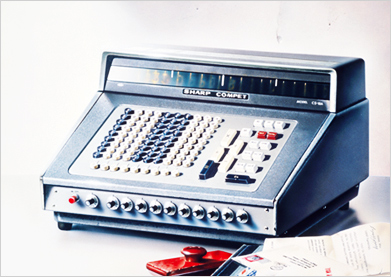
The company Sharp released a truly innovative product in June 1964. They must have known it was innovative, to price it higher than a car. Sharp's CS-10A was the first of its kind.
This machine was blue-grey with beautiful round buttons.
This machine was entirely electronic, with no mechanical parts, so it was completely silent and blazing fast.
This machine was designed to be used by anyone, anywhere, at any time.
This machine was miraculously the same size as a typewriter.
This new type of calculator, a real-life electric computer that might not have had any memory but still did not need a whole room or rack, needed a name so that it could be talked about. Just as the Germans are fond of their compound words, the Japanese see no reason not to throw words together until they form one noun either. Calculators were not always simply dentaku; this is the result of the natural Japanese urge to shorten things, such as "convenience store" to conbini or "personal computer" to paso-con.
Once upon a time, electronic calculators were fondly called 電子式卓上計算機: denshi-shiki takujou keisanki. Isn't it strange how we can get such a short word from such a long phrase? But when we parse this noun, it does finally explain why the word "calculator", an invention now known for being small and convenient, has the word "table" in it.
- 電子
- denshi, electric
- 式
- shiki, type (or style)
- 卓上
- takujou, tabletop (or desktop)
- 計算
- keisan, calculation
- 機
- ki, machine (or loom; if you know computer history, this makes more sense than you may think at first.)
This is an electronic calculator—as opposed to the good old fashioned mechanical ones, and it's so small that it can fit entirely on your desk. And so the Electronic-type Desktop Calculation Machine appears and changes our lives for the better. They are so thoroughly changed, in fact, that many parts of the phrase even become redundant.
Over time, calculators have come to be powered by electricity by default. They are usually small enough to fit on a desk, too. So why bother say the full thing? Not only is it catchier than denshi-shiki takujou keisanki, it's easier to tell your subordinate to punch some numbers into his dentaku, too.
And thus, the Japanese pocket calculator is forever stuck with the name of "electric table"...